

Author, Steve Davies | The Local Business Network
Most of the time, I write about practical ways to help business owners grow—how to build a stronger online reputation, improve their visibility, optimize their business profile, or earn more five-star reviews. Those are all important topics because they help businesses succeed.
But today, I want to write about something different.
This article is for the entrepreneur with the heart of a lion. The one who works a full-time job during the day and then spends evenings, weekends, and countless late nights pouring every ounce of energy into a dream. The one who is constantly thinking, planning, learning, and asking, "How can I make this business better?" If that's you, I hope you'll keep reading.
Every entrepreneur starts a business with the hope of creating more freedom, more income, and a better future. Yet somewhere along the way, it's easy to become consumed by the daily demands of running a business and lose sight of what you're really creating.
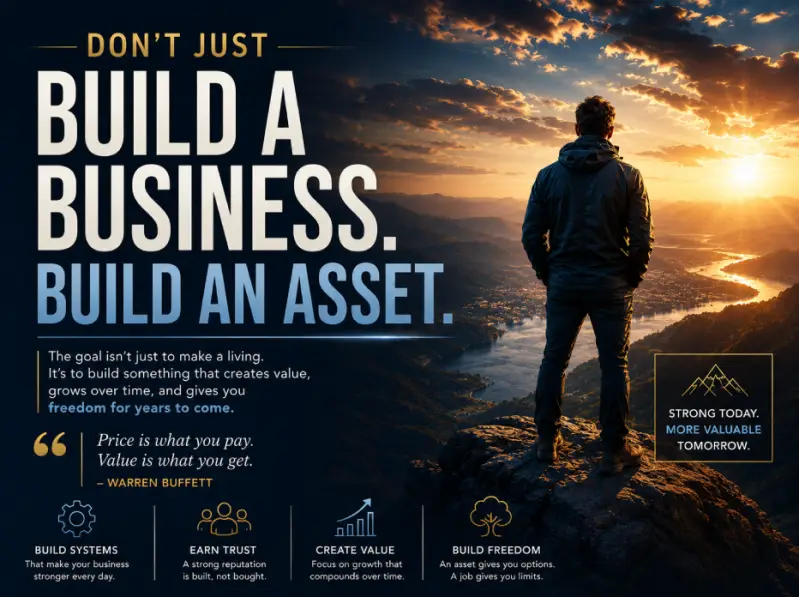
In today's article, I want to share a perspective that has completely changed the way I look at entrepreneurship. It's the realization that the most successful business owners don't just build businesses—they build assets. Assets that grow in value year after year, create long-term wealth, and may one day become one of the greatest investments they'll ever make.
Most people start a business for one reason: they want more freedom.
Freedom from a difficult boss. Freedom to set their own schedule. Freedom to earn what they believe they're worth. Freedom to create something that belongs to them instead of spending their lives building someone else's dream.
There is nothing wrong with those goals. In fact, they are often what give entrepreneurs the courage to take that first frightening step into business ownership.
Yet somewhere along the way, something unexpected happens. The business that was supposed to create freedom begins demanding more time than the job it replaced. Days become longer. Vacations become shorter. Evenings disappear into paperwork, phone calls, and unfinished projects. The owner discovers they haven't escaped the daily grind at all—they've simply traded one version of it for another.
For many people, that's where the story ends. They spend years, sometimes decades, working tirelessly until retirement finally arrives. They close the doors, sell off a few pieces of equipment, thank their loyal customers, and quietly move on. Their business provided a living, but very little beyond that.
It doesn't have to end that way.
One of the most valuable lessons an entrepreneur can learn is that a business should become more valuable every year it exists. Not simply more profitable, although profit certainly matters. Value and profit are not always the same thing. Profit pays today's bills. Value shapes tomorrow's opportunities.
That difference is easy to overlook when you're consumed by the demands of running a company. Every day presents another problem to solve, another customer to serve, another invoice to send, another decision to make. It becomes easy to judge success by this month's revenue or this quarter's earnings.
Successful investors often look at businesses very differently. They don't simply ask, "How much money did it make this month?" They ask a far more interesting question: "If I bought this company tomorrow, what would I actually be buying?"
That question has a way of changing everything.
Would they be purchasing a well-run organization with loyal customers, documented systems, a respected reputation, and dependable revenue? Or would they simply be buying someone else's full-time job?
It's a difficult question because many small businesses are built entirely around one person. The owner answers every important phone call, makes every major decision, solves every problem, and carries the entire operation on their shoulders. While that level of dedication is admirable, it also creates a hidden weakness. If the owner steps away, even briefly, the business begins to struggle.
A company like that may produce an excellent income, but it often has limited value to someone else.
An asset is different.
An asset continues creating value whether you're standing beside it or not. A rental property earns income while you sleep. A well-written book continues selling years after it was published. A carefully built investment portfolio grows over time through the power of compounding.
A great business can do exactly the same thing.
That doesn't mean the owner becomes unnecessary. It means the business becomes bigger than any one individual. It develops its own momentum, its own identity, and its own ability to create opportunity.
This shift in thinking changes the purpose behind the work you do every day.
Instead of asking, "How do I get through another busy week?" you begin asking, "How do I make this company stronger than it was yesterday?"
Those are very different questions.
The first is about survival.
The second is about building something with lasting value.
Legendary investor Warren Buffett famously observed, "Price is what you pay. Value is what you get." While he was referring to investing, the principle applies just as well to entrepreneurship. The market ultimately rewards businesses that create genuine value, not merely those that stay busy.
Creating value often happens quietly.
It appears in better systems that eliminate unnecessary work. It appears in stronger relationships with customers who return year after year because they trust you. It appears in employees who understand the company's mission and carry it forward with pride. It appears in a reputation that has been earned patiently over many years through honesty, consistency, and quality.
None of these things make headlines.
Most of them aren't glamorous.
Yet together they form the foundation of businesses that stand the test of time.
Many entrepreneurs become discouraged because progress rarely feels dramatic. They imagine success arriving in one spectacular moment—a breakthrough contract, a viral marketing campaign, or a record-breaking month of sales. While those moments certainly happen, they are rarely what determines the long-term value of a company.
Businesses are built much the same way beautiful cathedrals were constructed centuries ago. The workers who laid the first stones knew they might never see the finished structure. Even so, every stone was placed with care because each one supported everything that would eventually rise above it.
Business ownership demands that same perspective.
Every improvement matters, even when no one notices it today.
Every lesson learned from a difficult customer has value.
Every process that saves ten minutes today may save hundreds of hours over the next decade.
Every investment in quality strengthens the foundation upon which tomorrow's success will rest.
This is where patience becomes one of an entrepreneur's greatest competitive advantages.
We live in a culture that celebrates overnight success, but genuine business success almost never arrives overnight. Companies that endure for decades are usually built through thousands of ordinary days filled with thoughtful decisions that seem insignificant at the time.
Author James Clear writes that every action you take is a vote for the type of person you wish to become. The same could be said of every decision you make in business. Every decision is a vote for the type of company you are building.
Over time, those votes accumulate.
Eventually they define your reputation, your culture, your profitability, and your company's value.
Perhaps the greatest irony in entrepreneurship is that the business owners who think about selling their companies from the very beginning are often the ones who never feel pressured to sell them at all. By building organizations that others would gladly purchase, they create businesses that provide them with more freedom, more options, and greater financial security throughout the journey.
Thinking about an exit strategy isn't pessimistic. It isn't about planning to walk away. Quite the opposite. It is about making better decisions today because you understand that every decision shapes the future value of what you're creating.
Whether you eventually sell your company, pass it on to your children, or simply continue enjoying the work for decades to come becomes almost secondary.
The real reward is knowing you've built something that has lasting worth.
Something that can thrive because of your leadership rather than depend entirely upon your presence.
Every entrepreneur experiences days when exhaustion sets in and progress feels painfully slow. During those seasons, it helps to remember that remarkable businesses are rarely built in moments of excitement. They are built on ordinary Tuesdays, in quiet offices, on job sites, behind storefront counters, and around conference tables where owners continue making good decisions long after the initial excitement has faded.
That is the work that compounds.
That is the work that creates opportunity.
And that is the work that transforms a small business into something far more significant than a source of income.
So as you unlock your office tomorrow morning, answer your first email, greet your first customer, or begin planning your next project, remember that your goal isn't simply to make it through another day.
Your goal is to leave your business just a little stronger than it was yesterday.
Do that consistently for years, and one day you'll discover that you didn't merely build a business.
You built an asset.
And assets have a remarkable way of creating freedom long into the future.
If you want help building toward that, a marketing consultation is a good place to start.