Author, Steve Davies|LocalBizNet.com
When someone searches for your business online, they expect to find accurate information.
They want to know who you are, where you're located, how to contact you, and whether they're looking at the right business. What many business owners don't realize is that this information may be scattered across dozens of websites, apps, maps, directories, and online databases—sometimes with conflicting details.
Your website may display one phone number while an old directory listing displays another. Your Google Business Profile may include a suite number that doesn't appear elsewhere. A social media profile might use a slightly different version of your business name than the one listed on your website.
While these inconsistencies may seem minor, they can create confusion for customers and make it more difficult for search engines, maps, review platforms, and AI-powered search tools to confidently understand and recommend your business.
This is where NAP consistency comes into play.
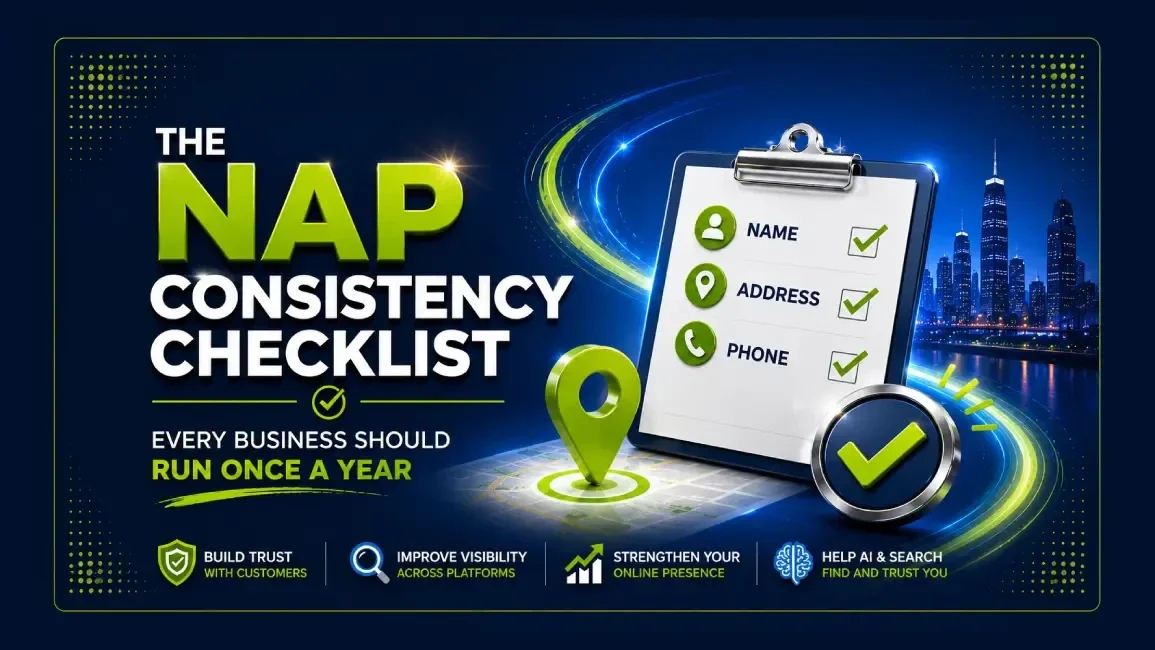
NAP stands for Name, Address, and Phone Number. These three pieces of information serve as the foundation of your business's online identity. The more consistently they appear across the internet, the easier it becomes for both people and technology to verify that your business is legitimate, active, and trustworthy.
Although NAP consistency has long been associated with local SEO, it has become increasingly important in the age of artificial intelligence. Today's search tools don't simply rely on a single source of information. They gather data from multiple websites and compare what they find. When your business information matches across those sources, confidence increases. When it doesn't, uncertainty grows.
If you've ever wondered why ChatGPT, Gemini, or Google's AI Overviews sometimes recommend a competitor instead of your business, inconsistent business information is often part of the problem. AI systems are constantly evaluating information from websites, business profiles, directories, reviews, and other online sources. The businesses that tend to appear most often in AI-generated recommendations are usually the ones that create the highest level of confidence.
NAP consistency is only one piece of that puzzle, but it's an important one. For a broader look at how AI-powered search tools decide which businesses to recommend—and the other factors that influence those recommendations—read our guide:
Why Does ChatGPT Recommend My Competitor Instead of Me?
Why Consistent Business Information Matters
Think about how people search for businesses today.
Some use Google. Others rely on Apple Maps, Bing, Yelp, Facebook, industry directories, or voice assistants. Increasingly, consumers are also turning to AI-powered search tools to help them find products, services, and local businesses.
None of these platforms operates in complete isolation. They gather information from various sources and compare it against other publicly available data.
Imagine a business called ABC Plumbing. On its website, the company is listed as "ABC Plumbing Services." On Facebook, it's listed as "ABC Plumbing." A directory site still displays an old phone number, while another listing shows a previous office location.
A customer might eventually figure out that all of these listings refer to the same business. An AI system, however, doesn't make assumptions. It looks for patterns and consistency. The more conflicting information it finds, the harder it becomes to determine which details are accurate.
This doesn't necessarily mean your business will disappear from search results. It simply means you're making it more difficult for technology—and potential customers—to trust the information they find.
Start With Your Official Business Information
Before you begin searching for inconsistencies, establish a single source of truth.
Open a document and record exactly how your business information should appear online.
This should include your official business name, complete address, primary phone number, and website URL.
Think of this document as your master record. Every listing you review during your audit should match it as closely as possible.
Without a clear standard, it's easy to introduce new inconsistencies while trying to fix old ones.
Finding Your Business Listings
One of the simplest ways to uncover listing issues is to search for your business the same way a customer would.
Start by searching your business name in Google. Then search your business name along with your city. You can also search your phone number, address, and website URL.
As you review the results, pay attention to any websites displaying your business information. You may discover listings you forgot existed or directories you never knew contained your information in the first place.
Create a simple spreadsheet and record each listing you find. Include the website name, URL, business name shown, address shown, phone number shown, and whether the information is accurate.
This process often reveals far more listings than business owners expect.
Where NAP Information Usually Starts to Drift
In most cases, inaccurate listings are not the result of negligence. They occur naturally over time.
Perhaps your business moved to a new location. Maybe you changed phone providers or updated your website. Sometimes an employee creates a business profile on a platform and forgets about it. Other times, directories pull information from third-party databases and create listings automatically.
One of the most common issues is business name variation. A company may be listed as "ABC Plumbing" on one platform, "ABC Plumbing LLC" on another, and "ABC Plumbing Services" somewhere else.
Address inconsistencies are equally common. A suite number may appear on one listing but not another. An old office location might still exist on a directory that hasn't been updated in years.
Phone numbers can create problems as well, particularly if a business has changed numbers, used call-tracking numbers for advertising campaigns, or maintained multiple contact numbers over time.
Then there are duplicate listings. These often appear after a business relocation, ownership change, or accidental creation of multiple profiles on the same platform. Duplicate listings can confuse customers and dilute trust in your business information.
Correcting Listings You Control
The easiest listings to update are the ones you own.
Start with your website, Google Business Profile, Apple Maps, Bing Places, Facebook page, LinkedIn profile, and any other business profiles you actively manage.
As you review each platform, compare the information against your master record. Confirm that your business name, address, phone number, website URL, and business hours are all accurate.
Many business owners focus only on their homepage and forget about contact pages, website footers, location pages, appointment booking systems, and social media profiles. Make sure every public-facing source reflects the same information.
Correcting Listings You Don't Control
Not every listing can be edited directly.
Fortunately, most directories provide a method for claiming ownership or requesting corrections.
If a listing contains inaccurate information, look for options such as "Claim This Business," "Own This Listing," or "Suggest an Edit." Once ownership has been verified, many directories allow you to update the information yourself.
If no claim option exists, search for a contact form or support request page. Most directory operators will correct inaccurate information when provided with proper documentation.
Duplicate listings should also be addressed whenever possible. Requesting a merge or removal helps eliminate confusion and creates a cleaner online presence.
Why AI Models Pay Attention to NAP Consistency
As artificial intelligence becomes a larger part of how people search for information, consistency matters more than ever.
AI systems are designed to evaluate confidence. They compare information from multiple sources and look for agreement. When numerous websites display the same business name, address, and phone number, confidence increases that the information is accurate.
When those sources disagree, confidence decreases.
This doesn't mean a single typo will prevent your business from appearing in AI-generated recommendations. However, dozens of inconsistencies spread across directories, maps, and business listings can create uncertainty that affects how confidently a system references your business.
The goal is not perfection. The goal is clarity.
The easier you make it for people and technology to verify your business information, the stronger your digital presence becomes.
Your Annual NAP Consistency Checklist
At least once each year, take a few minutes to review the following:
✓ Verify your business name is consistent across all major platforms.
✓ Confirm your address matches your official business address everywhere it appears.
✓ Verify your primary phone number is consistent across listings.
✓ Check your website URL for accuracy.
✓ Review your Google Business Profile.
✓ Review your Apple Maps and Bing Places listings.
✓ Review your social media business profiles.
✓ Search for outdated phone numbers and addresses.
✓ Search for duplicate business listings.
✓ Correct listings you control.
✓ Request corrections for listings you don't control.
✓ Update your spreadsheet with any changes made.
A Small Investment That Protects Your Online Visibility
Most business owners spend considerable time and money attracting customers to their websites, social media pages, and business profiles. Yet many never stop to verify whether the information customers find is accurate.
An annual NAP audit doesn't take long, but it can help eliminate confusion, improve trust, and ensure that customers, search engines, maps, directories, and AI-powered search tools are all working with the same information.
In a digital world where information travels quickly and is copied across countless platforms, consistency remains one of the simplest ways to strengthen your online presence.
If you're auditing your listings, our services FAQ covers the related basics of local visibility.
Complimentary Business Listing & NAP Audit
Not sure whether your business information is consistent across the web?
At LocalBizNet, we offer a complimentary business listing and NAP audit designed to help business owners identify outdated information, duplicate listings, and inconsistencies that may be affecting their online visibility.
We'll review your major business listings, compare them against your current business information, and provide practical recommendations for correcting any issues we discover.
There is no obligation and no high-pressure sales presentation. Our goal is simply to help you understand how your business appears online and where opportunities for improvement may exist.
This kind of consistency check is part of every local SEO audit we run - see our local SEO service."