

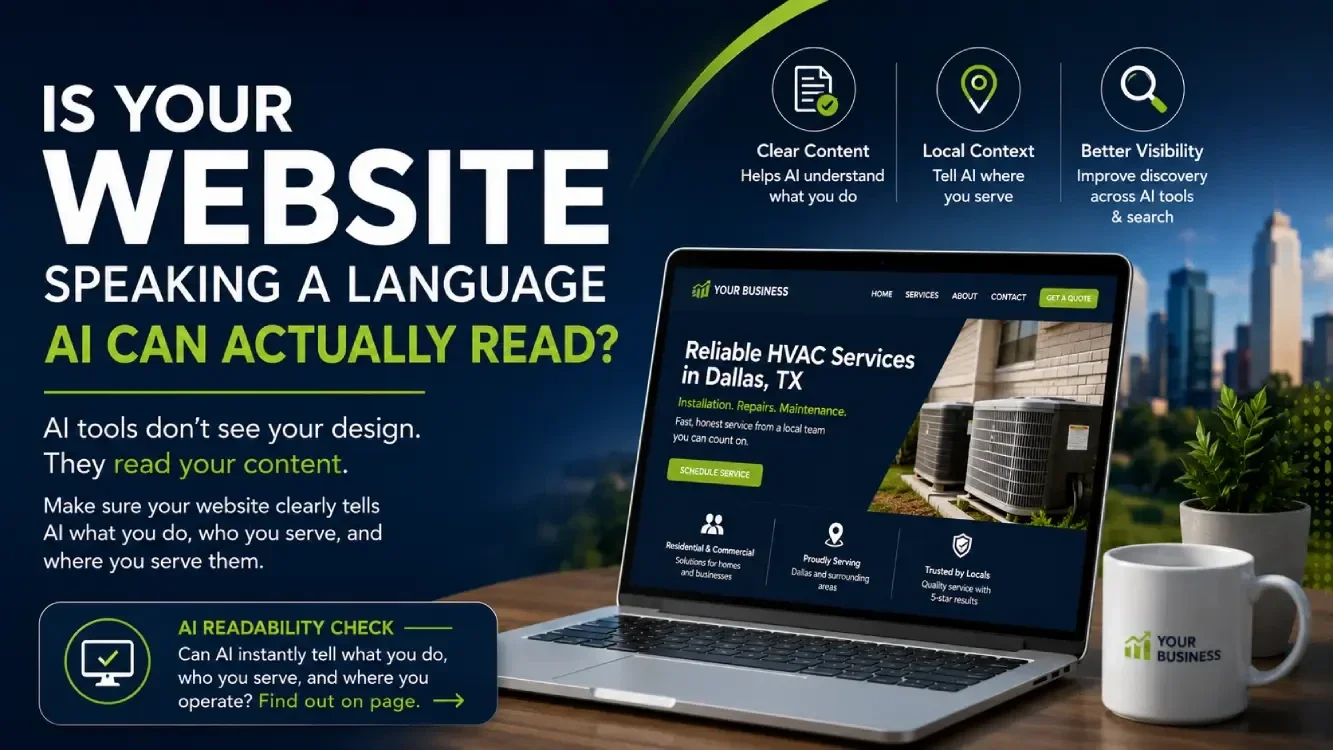
Most business owners judge their website by the same criteria their customers use.
They look at the design, the images, the colors, the layout, and the overall professionalism of the site. If it looks modern, loads quickly, and accurately represents the business, it's easy to assume everything is working as it should.
And for human visitors, that may be true.
The problem is that your website has another audience—one that doesn't experience it the same way people do.
Search engines, AI-powered search tools, voice assistants, and large language models aren't evaluating your website based on visual appeal. They aren't impressed by flashy animations, stunning photography, or clever design elements. Their primary goal is much simpler: they are trying to understand what your business does, who you serve, and why someone might choose you.
Surprisingly, many websites make that difficult.
A website can look beautiful to a human visitor while providing very little information that search engines and AI systems can easily understand. As AI becomes a larger part of how consumers find businesses online, that gap is becoming increasingly important.
The Difference Between What Humans See and What AI Reads
When a potential customer visits your website, they absorb a tremendous amount of information almost instantly.
They notice your logo, your photos, your color scheme, your branding, and the overall feel of the site. Even before they begin reading, they are forming opinions about your company.
AI systems work differently.
While modern AI is becoming increasingly sophisticated, it still relies heavily on information it can extract and interpret. It looks for written content, headings, page structure, service descriptions, business details, and other contextual clues that help explain what your company actually does.
Think of it this way: a visitor may look at a photograph of a roofing crew standing on top of a house and immediately understand that you're a roofing contractor. AI may recognize the image, but it gains much greater confidence when it also finds text that says, "Residential and Commercial Roofing Services in Houston, Texas."
Humans naturally fill in the blanks. AI systems prefer not to.
The clearer your website communicates in plain language, the easier it becomes for technology to understand your business.
When Great Design Creates a Visibility Problem
Over the past decade, website design trends have shifted dramatically.
Many modern websites feature large hero images, full-screen videos, minimal text, animated graphics, and marketing slogans designed to create an emotional impact. These elements can be effective for branding, but they sometimes come at the expense of clarity.
Imagine visiting a homepage that features a stunning background video and a headline that reads:
"Helping You Reach New Heights."
It sounds professional. It sounds inspiring.
But what does the company actually do?
Without additional context, it could be a marketing agency, a business coach, a commercial construction company, a financial planner, or dozens of other types of businesses.
This is where many websites unintentionally create an AI visibility problem.
Business owners often assume visitors already know what they do because the answer seems obvious to them. But search engines and AI systems don't make assumptions. They look for evidence.
If your homepage relies heavily on visuals while offering very little descriptive text, you may be forcing both visitors and technology to work harder than necessary.
This issue has become increasingly important as AI-powered search tools begin playing a larger role in how consumers discover businesses. A website that looks impressive but fails to clearly explain what a company does can create uncertainty—not only for potential customers but also for the AI systems deciding which businesses to recommend.
If you've ever wondered why ChatGPT, Gemini, or Google's AI Overviews seem to recommend a competitor instead of your business, website clarity is often part of the answer. AI systems rely on a combination of signals—including website content, business listings, reviews, Google Business Profiles, and online discussions—to determine which businesses they understand best.
For a broader look at how AI-powered search tools decide which businesses to recommend, read our guide:
Why Does ChatGPT Recommend My Competitor Instead of Me?
The good news is that website clarity is one of the easiest visibility issues to improve once you know what to look for.
The Importance of Saying What You Do
One of the simplest improvements a business can make is also one of the most overlooked.
Clearly state what you do.
That may sound obvious, but many websites fail this test.
Instead of directly describing their services, businesses often lead with vague marketing language:
"Creating Better Experiences."
"Solutions Built Around You."
"Helping Businesses Grow."
There's nothing inherently wrong with these statements, but they don't explain what the company actually does.
A visitor shouldn't have to guess whether you're a roofing contractor, a law firm, an accountant, a plumber, or a marketing agency.
Neither should AI.
The businesses that tend to perform best in search and AI-driven discovery are often the ones that communicate clearly and directly. They tell visitors exactly what they do, who they serve, and where they operate.
Clarity almost always outperforms cleverness.
Can Someone Understand Your Business in Ten Seconds?
Here's a simple exercise.
Open your homepage and pretend you've never seen it before.
Now imagine a complete stranger lands on the page.
Within ten seconds, can they answer four basic questions?
What does this company do?
Who do they serve?
Where do they provide services?
Why should someone choose them?
If those answers aren't immediately obvious, there's a good chance your website is creating unnecessary friction.
This doesn't mean your website is bad. It simply means there may be opportunities to communicate more clearly.
Many businesses discover that the information exists somewhere on the site, but it's buried several pages deep or hidden beneath layers of marketing language.
The goal isn't to eliminate creativity. The goal is to make sure clarity comes first.
Why Text Still Matters
There is a common misconception that AI can fully understand everything on a website regardless of how the information is presented.
While AI technology continues to improve, text remains one of the most reliable ways to communicate information.
A page filled with beautiful images may impress visitors, but images rarely provide the same level of detail as written content.
For example, a photograph can show a completed kitchen remodel. A paragraph can explain that you specialize in custom kitchen renovations, cabinet installation, countertop replacement, and design services for homeowners throughout a specific service area.
One provides visual appeal.
The other provides context.
The strongest websites use both.
They combine compelling visuals with clear explanations that help visitors and technology understand exactly what the business offers.
The Next Level: Schema Markup
Once your website clearly communicates who you are, what you do, and where you operate, there are additional ways to help search engines understand your business.
One of the most effective is schema markup.
Schema is a type of structured data that exists behind the scenes of your website. Visitors never see it, but search engines and other systems can use it to better understand your business information, services, products, reviews, locations, and other important details.
Think of it as adding labels to information that already exists on your site.
If clear website content is like speaking clearly during a conversation, schema markup is like providing written notes to make sure nothing gets misunderstood.
For most businesses, however, schema should be viewed as an enhancement—not a substitute for clear content.
The foundation still starts with making sure your website plainly explains who you are and what you do.
A Quick AI Readability Test
If you're curious whether your website is communicating effectively, spend a few minutes reviewing your homepage and asking yourself the following questions:
✓ Does the homepage clearly state what your business does?
✓ Does it identify who your ideal customers are?
✓ Does it mention the cities, regions, or areas you serve?
✓ Are your primary services described in plain language?
✓ Is important information presented as text rather than only within images?
✓ Could a first-time visitor understand your business within a few seconds?
If you find yourself answering "no" to several of these questions, your website may be more difficult for AI systems—and potential customers—to understand than you realize.
The good news is that these issues are often relatively easy to correct.
Visibility Starts With Understanding
Many conversations about AI visibility quickly become technical.
Business owners hear terms like structured data, schema markup, vector search, embeddings, and machine learning. Before long, the discussion feels overwhelming.
In reality, the foundation of AI visibility is surprisingly simple.
Can your website clearly explain who you are, what you do, who you serve, and where you operate?
If the answer is yes, you're already ahead of many businesses.
The easier you make it for people and technology to understand your company, the easier it becomes to be discovered, recommended, and trusted online.
As AI-powered search continues to evolve, clarity is no longer just good marketing—it is becoming an essential part of online visibility.
Complimentary AI Website Visibility Review
Wondering whether your website is speaking a language AI can actually understand?
At LocalBizNet, we offer a complimentary AI Website Visibility Review designed to identify common issues that may be limiting your online visibility.
We'll review your homepage, service pages, content structure, business information, and overall AI readability to determine how easily search engines and AI-powered search tools can understand your business.
There is no obligation and no high-pressure sales presentation. You'll simply receive practical insights and recommendations that can help improve how your business is understood online.
Contact LocalBizNet today to request your complimentary AI Website Visibility Review and discover whether your website is helping—or hindering—your visibility in the age of AI.