Author, Steve Davies|LocalBizNet.com
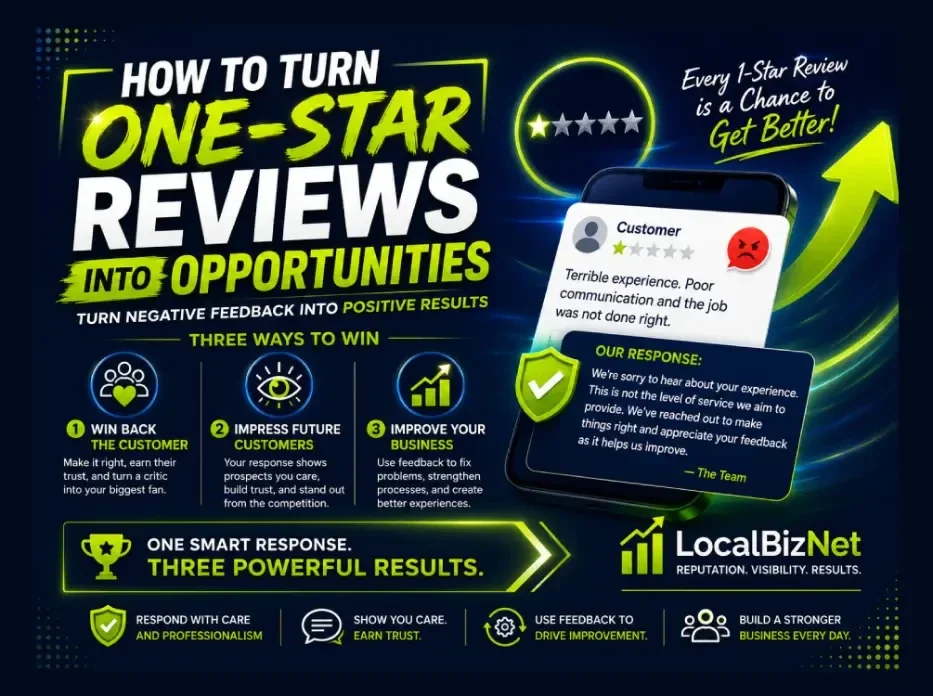
The first instinct when a one-star review lands is almost always the wrong one. Defensive. Hurt. Maybe a little angry. Wanting to type a response that sets the record straight before the rest of the world sees it. Resist all of that. The most successful business owners — the ones whose profiles quietly outperform their competitors year after year — see one-star reviews very differently. To them, a one-star review isn't a crisis. It's a moment of compressed opportunity, useful in three completely separate ways at once.
This article is about the mindset and the mechanics of turning that bad review into something genuinely valuable for your business — for the original customer, for the next thousand prospects who'll read it, and for the operation behind the scenes that produced it.
Three Audiences for Every One-Star Review
The first reframe: a one-star review isn't really one piece of content. It's three audiences hearing three different things, all from the same review.
Audience 1: The reviewer themselves. The person who left it. Sometimes they can be won back. Often they can't. But they're the smallest audience of the three, and the one the review is least about going forward.
Audience 2: Future prospects. Every customer who lands on your profile from now until the review is buried under newer ones. This is the largest audience and the one most owners underweight.
Audience 3: You and your team. The people inside your business who can use the review as raw data — what went wrong, what almost went wrong, what to fix.
A great owner response and follow-through serves all three audiences at once. Most owners only think about the first one, which is exactly why most responses don't land.
Opportunity #1: Win the Reviewer Back
The original customer is the longest shot, but it's worth a real effort. Not because every winback works, but because the few that do are some of the most powerful word-of-mouth events your business will ever have.
A customer who left a one-star review and then had a genuinely great resolution experience often becomes a louder advocate than a customer who simply had a smooth experience the first time. They've already cared enough to write about you publicly. If you turn that energy around, they sometimes update the review to four or five stars, sometimes write a separate glowing follow-up, and almost always tell people about it.
The mechanics of winning a reviewer back:
Respond publicly first, calmly and warmly. Acknowledge the issue without arguing details. Take ownership where it's warranted. Invite them to contact you directly.
Then make a real, off-platform effort. A phone call from the owner. A handwritten note. A genuine attempt to make it right with no expectation of anything in return. Don't ask them to update the review. The point is to be the kind of business that does right by people.
Follow through fully. If you promise something, do it on time and well. If you can't fully fix what happened, be honest about why and offer the most reasonable alternative you can.
Then let them decide. Some customers will update the review unprompted. Some will write a new one. Some won't change anything publicly but will refer others. All three outcomes are wins.
A roofing company in Cypress that handles a botched installation badly loses one customer. The same company handling it gracefully — owner shows up personally, redoes the work, doesn't haggle — often turns that customer into the most enthusiastic referral source they'll get all year.
Opportunity #2: Signal Quality to Future Prospects
This is the audience most owners forget, and it's the most valuable.
When a future prospect lands on your profile and sees a one-star review, they'll do exactly what you'd do in their position: scroll to your response. Your response is a public audition for every prospect from now on. The reviewer might not even read it. The next 500 prospects will.
A great response to a one-star review can do more for your reputation than a dozen new five-star reviews. Here's what it should do:
Stay calm. No defensiveness, no sarcasm, no scoring points. Tone matters more than content.
Acknowledge the experience. Not necessarily agree with their version of events, but recognize that the experience clearly didn't go well from their perspective.
Take ownership where you should. If your team genuinely dropped the ball, say so. Future readers respect ownership.
Add missing context briefly, if it really matters. Without making the customer look bad. The phrase "we clearly didn't communicate this well" is a small piece of magic that owns the gap without throwing the customer under the bus.
Move it offline. Provide a real contact method and a real name. This signals you're willing to engage rather than hide.
Keep it short. Two or three short paragraphs is plenty. Long defensive responses always look worse than the original review.
When a prospect reads a response like that, the one-star review has been transformed. Instead of "this business has a problem," they read "this business handles itself well when things go wrong, which is exactly the kind of business I want to do business with."
That's the conversion math right there: one bad review, paired with a great response, often performs better than a perfect five-star average that looks suspicious.
Opportunity #3: Use the Feedback to Improve the Business
The third audience — your team — gets the most underrated benefit. Reviews are some of the cleanest customer feedback you'll ever get, and one-star reviews specifically are signal-rich.
When you read a one-star review carefully, ask:
Is this a one-off, or a pattern? If three customers in a row mention the same issue, you have a real operational problem. If only one customer in two years has ever mentioned it, it's probably a one-off.
Is it a process problem or a person problem? Sometimes a specific team member is creating bad experiences. Sometimes the process itself is broken in a way that anyone in that role would handle badly.
Is it a customer expectation mismatch? Sometimes the experience genuinely went how it should — but the customer expected something different from the start. That's a marketing or communication problem upstream of the service itself.
Is there a small, cheap fix? Often the issue is something tiny: a clearer follow-up email, a 15-minute training, a checklist update. The fixes that come from one-star reviews are usually some of the highest-ROI process improvements a business will make.
A landscaping company in Spring that started reading their one-stars carefully realized that 80% of their negative reviews mentioned communication gaps — not the actual quality of the work. They added one automated text update during long jobs, and their one-star rate dropped meaningfully within the next quarter. Free fix, found in the reviews.
The Trap: Reading One-Stars Defensively
The biggest barrier to using one-star reviews well is the emotional reaction to them. Every owner has it. The instinct is to read the review looking for what's wrong with it — the customer's misunderstanding, the unfair characterization, the fact that they didn't follow your instructions. Once you're in that mode, you stop being able to read it for signal.
A practical workaround: read every negative review twice. The first time, vent. Mutter. Argue with it in your head. Get the emotional reaction out of your system. Then walk away. Come back twenty minutes later (or the next morning) and read it a second time, this time looking only for the part that's true. Almost every negative review contains some truth, even when most of it is wrong. The truth is the gold.
If you find yourself genuinely unable to find anything true or useful in a review, that's a signal too — usually that the review is either fake, malicious, or from someone with an axe to grind unrelated to your business. Those situations are different and have their own playbook.
Templates for Common One-Star Situations
A starting point for the most common one-star scenarios. Adapt to your voice — these aren't meant to be copy-paste:
You actually messed up:
"Hi [Name], thank you for taking the time to share this — and we're sorry. You're right that [briefly acknowledge what went wrong]. That's not the experience we want anyone to have. We've already [brief, concrete action] so this doesn't happen again. If you're open to it, I'd like to make this right personally — please reach me at [phone] or [email]. — [Owner's name]"
The customer is missing context:
"Hi [Name], thank you for the feedback — we always want to know when something didn't go the way a customer hoped. From our records, [briefly add the missing context calmly]. That said, we clearly didn't communicate this well, and we own that. I'd love to talk through it directly to see if we can make it right. Please reach out to me at [phone] or [email]. — [Owner's name]"
Vague one-star with no detail:
"Hi [Name], we're sorry to see a one-star rating — we'd genuinely like to understand what didn't work for you so we can address it. If you have a moment to share more, please reach me directly at [phone] or [email]. — [Owner's name]"
Reviewer wasn't a customer:
"Hi [Name], thank you for the feedback. We take every review seriously, but we don't have a record of any customer matching these details, and the services described don't match what we offer. There may have been a mix-up with another business, or we've somehow missed you in our records. Either way, please reach out to me at [phone] or [email] so we can look into this. — [Owner's name]"
The structure of all four is the same: acknowledge, take appropriate ownership, offer a real off-platform contact. It's the same approach you'd take in person if a customer raised an issue at your front desk in The Heights or Bellaire — you wouldn't argue with them in front of other customers. Same logic online.
What "Turning It Into an Opportunity" Actually Looks Like Long-Term
The owners who handle one-star reviews best aren't doing magic. They've built habits:
They respond to every review, positive and negative, within 24 to 48 hours.
They draft responses to negative reviews carefully, not in the heat of the moment.
They follow up off-platform when there's a real chance to make things right.
They read every negative review for signal — and act on patterns when they find them.
They don't argue publicly. Ever.
They keep building real review volume, so any one bad review fades naturally over time.
Do those things consistently, and one-star reviews stop being threats. They become small inputs into a system that's quietly making the business better, more credible, and harder for competitors to catch.
We have more article that may help you in responding to fake or negative reviews in these links:
how-to-report-a-fake-google-review
how-to-ask-for-reviews-that-actually-say-something
what-should-i-do-about-fake-or-unfair-google-reviews
Get Help Turning Tough Reviews Into Wins
Knowing what to do with a one-star review is one thing. Doing it well — at 9pm, when your guard is down, when the review is unfair — is another. This is exactly where having a calm, experienced second set of eyes pays off.
A great response is only half the system — our FAQ page covers the rest of what goes into managing reviews well.
At LocalBizNet.com, we draft responses to negative reviews for Houston-area businesses every week — calm, professional, on-brand replies that protect reputations while owners focus on the actual work of running the business. We also help spot patterns in negative reviews that point to real, fixable issues, so the operational improvements stack alongside the reputational ones.
If you'd rather not manage this yourself, our reputation management service does this for you.
Frequently Asked Questions For This Article