Conroe, Texas: From Lumber Town to Lake Conroe Community
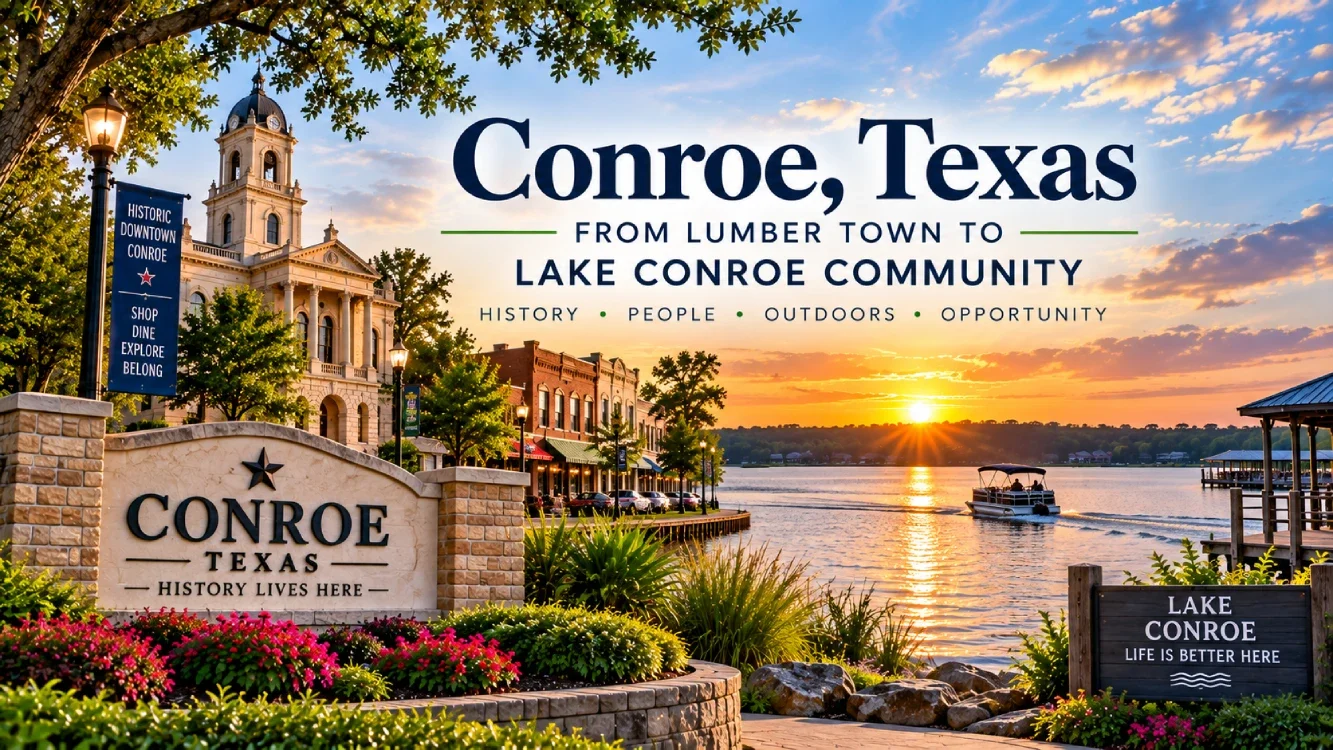
Conroe occupies an important place in the northern part of the Houston metropolitan area. As the county seat of Montgomery County, it serves as a center for government, healthcare, shopping, business, and everyday services for communities throughout the region.
It’s also a city with a history closely tied to the industries that helped build Texas. Conroe began as a lumber settlement, experienced a remarkable oil boom in the 1930s, and has continued to grow into a modern city while preserving much of its historic downtown.
Today, Lake Conroe adds another dimension to the community. What was originally created as a water supply reservoir has become one of the area’s most popular destinations for boating, fishing, recreation, and lakeside living.
That combination of history, growth, and natural surroundings gives Conroe an identity that’s distinctly its own.
How Conroe Began
Conroe’s history begins with Isaac Conroe, a former Illinois cavalry officer who settled in Houston after the Civil War.
In 1881, Conroe traveled north into Montgomery County looking for an opportunity in the timber industry. He purchased land, established a sawmill, and built a small wooden tram line connecting the mill with the International-Great Northern Railroad.
The settlement that developed around the sawmill became known as “Conroe’s Switch.” When a post office opened in January 1884, Isaac Conroe became its first postmaster.
Timber drove the community’s early growth. The surrounding forests provided the raw material for lumber, while the railroad provided a way to move that lumber and other goods to growing markets.
By 1889, Conroe had grown enough to replace the town of Montgomery as the county seat of Montgomery County. The city was officially incorporated in 1904.
Its location along important railroad routes helped establish Conroe as a commercial center for the surrounding region.
The Oil Boom That Changed Conroe
The biggest transformation in Conroe’s early history came several decades later.
In 1931, wildcatter George Strake discovered the Conroe Oil Field. The discovery triggered an extraordinary period of growth and wealth.
By some accounts, Conroe became one of the wealthiest small communities in the country on a per-capita basis. The oil boom provided money for public improvements and helped transform the appearance of the city.
Some of the most recognizable buildings in downtown Conroe date from this period.
The Crighton Theatre opened in 1935, while a new Montgomery County Courthouse was completed in 1936. Both remain important landmarks in downtown Conroe today.
The oil boom also helped strengthen the local school system and contributed to Conroe’s reputation as an important center in Montgomery County.
Oil eventually became less dominant, but its influence can still be seen throughout the city’s historic core.
Historic Downtown Conroe
One of the more interesting things about Conroe is how much of its history remains visible in the middle of a rapidly growing city.
Downtown Conroe still centers around the historic courthouse square, where the Montgomery County Courthouse and Crighton Theatre remain prominent landmarks.
Historic buildings have been given new life as restaurants, shops, offices, entertainment venues, and other businesses.
That mix of old and new gives downtown Conroe a character that’s different from the newer commercial developments spreading along the city’s major roads.
The historic downtown is also an important part of Conroe’s identity as the county seat. Government offices and county services bring people into the area from communities throughout Montgomery County, while restaurants, entertainment, and local businesses give visitors reasons to stay.
Lake Conroe Changes the Picture
For many people, the first thing that comes to mind when they hear “Conroe” isn’t the courthouse or the city’s lumber and oil history.
It’s Lake Conroe.
The lake was created in 1973 as a joint project involving the City of Houston, the Texas Water Development Board, and the San Jacinto River Authority. It was originally intended as a backup water supply for Houston.
Over time, Lake Conroe developed into one of the region’s most popular recreational destinations.
The lake stretches roughly 21 miles and covers approximately 21,000 surface acres. Boating, fishing, water skiing, jet skiing, and other water activities attract residents and visitors throughout the warmer months.
The lake has also influenced residential and commercial development along its shoreline, creating a part of the Conroe area that feels very different from the older neighborhoods around downtown.
Life Around Lake Conroe
The lake isn’t simply a recreational attraction. It has become part of the lifestyle and economy of the surrounding community.
Homes, restaurants, marinas, resorts, golf courses, and other businesses have developed around the lake, attracting both permanent residents and visitors.
For people who enjoy being outdoors, the combination of Lake Conroe and the area’s parks and recreational facilities provides plenty of opportunities to spend time outside without traveling far from home.
At the same time, the lake helps give Conroe a sense of place that distinguishes it from other rapidly growing communities along the northern edge of the Houston metro.
A City That Keeps Growing
Conroe has experienced significant growth as Houston has expanded northward.
Interstate 45 has played an important role in that growth, providing a direct connection between Conroe, The Woodlands, Spring, and Houston to the south, while also connecting the city with Huntsville and communities farther north.
New residential developments have expanded the city’s footprint, while retail centers, restaurants, medical facilities, professional services, and other businesses have followed the growing population.
That growth has also changed Conroe’s role within the Houston region.
It’s no longer simply a small county seat north of Houston. Conroe has become a major population and commercial center in its own right while continuing to serve as the administrative hub for Montgomery County.
Schools and Education
Conroe Independent School District has grown alongside the community for more than a century.
The district traces its roots to the late 1800s and has expanded considerably as the population of Montgomery County has increased. Its service area now covers a large portion of the region surrounding Conroe.
For families considering the area, the school district is an important part of the community’s appeal, particularly as new residential development continues throughout Montgomery County.
Lone Star College also provides higher-education opportunities for students and adults in the surrounding area.
Getting Around Conroe
Interstate 45 is the primary transportation corridor through Conroe.
It provides access south toward The Woodlands and Houston and north toward Huntsville and other communities in the region. State Highway 105 is another important east-west route through the city, connecting Conroe with surrounding communities and Lake Conroe.
Because Conroe serves as the county seat, the city also attracts people from smaller communities throughout Montgomery County for government services, healthcare, shopping, employment, and other needs.
That makes Conroe’s customer base considerably larger than its immediate residential population.
Conroe’s Parks and Outdoor Recreation
Lake Conroe gets much of the attention, but outdoor recreation in Conroe extends beyond the shoreline.
The city and surrounding area include parks, walking areas, sports facilities, golf courses, and other recreational destinations.
Candy Cane Park and Carl Barton Jr. Park are among the local recreational areas that provide residents with places to exercise, play sports, enjoy family activities, and spend time outdoors.
The larger Montgomery County area also provides access to additional parks, trails, forests, and natural areas.
For a community that has experienced substantial development, maintaining access to outdoor recreation remains an important part of the area’s quality of life.
Conroe and Its Neighbors
Conroe is part of a larger network of communities that has grown rapidly over the past several decades.
The Woodlands lies to the south, while Montgomery, Willis, and other communities surround Conroe to the north and west. Lake Conroe and the communities along its shoreline create another important connection to the surrounding area.
Residents routinely cross these community boundaries for work, shopping, healthcare, restaurants, entertainment, and recreation.
That’s particularly important for local businesses.
A company located in Conroe may serve customers from Montgomery, Willis, Lake Conroe, The Woodlands, and other parts of Montgomery County. Likewise, businesses throughout the surrounding area compete for many of the same customers.
Doing Business in Conroe
Conroe’s continued growth creates opportunities for local businesses, but it also creates more competition.
New residents need contractors, home services, healthcare providers, restaurants, automotive services, professional services, retailers, and countless other businesses.
At the same time, established businesses are competing with newer companies entering the market.
For many customers, the search begins online.
Someone moving into the Conroe area may search Google for a dentist, plumber, restaurant, real estate professional, accountant, auto repair shop, or other local service before they know anything about the businesses available.
That makes local visibility important.
A business needs accurate information, a well-maintained Google Business Profile, a credible website, positive reviews, and a clear understanding of the communities it serves.
And because Conroe is a regional center, businesses shouldn’t necessarily think of their market as being limited to the city itself.
Why Local Reputation Matters in Conroe
Conroe has grown considerably, but it still maintains many of the characteristics of a community where local reputation matters.
Longtime residents often have established relationships with businesses they trust, while newcomers are looking for recommendations and information that can help them make decisions in an unfamiliar area.
Online reviews have become an important part of that process.
A potential customer may never have heard of a local business before searching for it. The information they find on Google, the company’s website, and review platforms can strongly influence whether they make contact.
For businesses competing in a growing market like Conroe, maintaining that online reputation is becoming just as important as maintaining the storefront.
Marketing Services for Conroe Businesses
LocalBizNet helps Conroe businesses reach customers across Montgomery County and the Lake Conroe area. We optimize Google Business Profiles so you show up in the Map Pack when nearby residents search, generate a steady stream of authentic Google reviews, and design fast, professional websites that turn visitors into customers. We also handle local SEO, social media management, branding, and video production, all coordinated as one strategy.
Whether your business is in historic downtown Conroe, along the I-45 corridor, or near Lake Conroe, we’ll show you exactly where you’re losing visibility and how to fix it.
Book a Free 30-Minute Strategy Call
Conroe’s Future
Conroe is still growing, and that growth is likely to remain one of the defining characteristics of the community.
New neighborhoods continue to expand the city’s residential footprint. Businesses are following those residents, while improvements to transportation and infrastructure continue to shape how the area develops.
At the same time, Conroe has something that many rapidly growing communities don’t have: a substantial history that remains visible.
The historic downtown, the Crighton Theatre, the courthouse square, and the city’s connection to the lumber and oil industries provide a sense of continuity.
Lake Conroe adds another defining feature, giving the community an important recreational and residential identity alongside its role as the county seat.
The result is a city that’s growing quickly without having to leave its history behind.