Spring, Texas: Where Historic Charm Meets Modern Growth
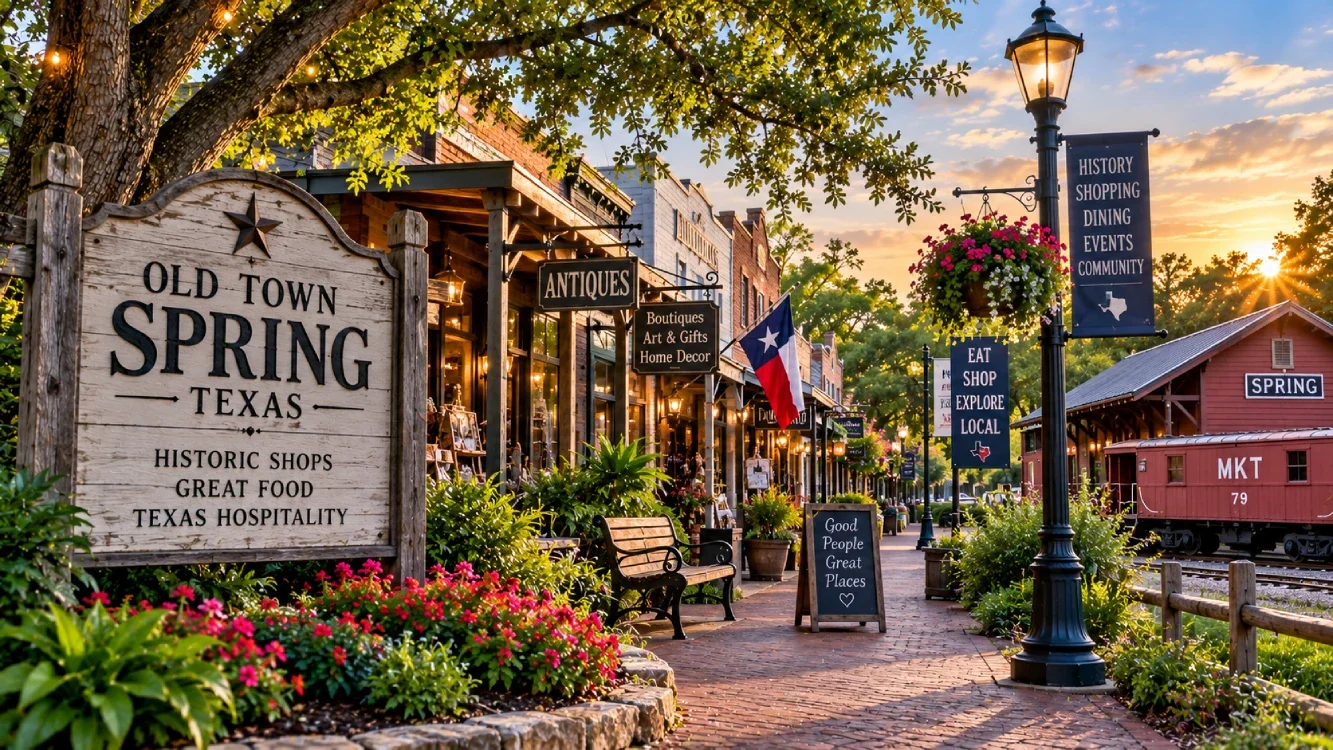
Spring, Texas, is one of those communities where the past and present are easy to see side by side.
At the center of the community is Old Town Spring, with its historic buildings, locally owned shops, restaurants, and long connection to the railroad. Surrounding it is a much newer and considerably larger suburban area that has grown along Interstate 45, the Hardy Toll Road, the Grand Parkway, and the communities surrounding The Woodlands.
That combination gives Spring an identity that’s different from many of the other communities around Houston. It has the conveniences and growth of a modern suburb while retaining a historic district that continues to attract visitors from throughout the region.
For businesses, that creates an interesting market. Spring isn’t just a residential community. It’s also a destination for shopping, dining, entertainment, recreation, and tourism, while its location puts it within reach of major employment centers throughout the Houston area.
A Railroad Town With Texas Roots
Spring’s history goes back to the German immigrants who settled in the area during the 1800s. The community developed gradually, but its future changed when the Houston and Great Northern Railroad reached Spring in 1871.
The railroad brought new opportunities and helped turn Spring into a growing commercial and transportation center. A post office followed in 1873, and by 1884, the community had mills, cotton gins, churches, schools, and a population of about 150.
Railroads continued to shape Spring’s development into the early 20th century. When the International-Great Northern Railroad extended service toward Fort Worth between 1901 and 1903, Spring became an important railroad switchyard.
Lumbering also became an important local industry, and the population grew substantially during this period.
Spring even has a connection to one of Texas’ more colorful pieces of local lore. The Spring State Bank, established in 1912, was robbed several times during the 1930s. One of those robberies has long been associated with Bonnie and Clyde, although that particular connection is generally considered part of local legend rather than established fact.
Old Town Spring
If there’s one place that best represents Spring’s historic character, it’s Old Town Spring.
As Houston expanded northward during the second half of the 20th century, residential development began surrounding the original railroad community. Rather than allowing the historic buildings to disappear, local efforts eventually focused on preserving and revitalizing the area.
The Old Town Spring Association was formed in 1980 to promote the historic district, and the area gradually developed into a destination for visitors looking for something different from the typical suburban shopping experience.
Today, Old Town Spring is home to more than 100 shops, restaurants, galleries, and other businesses located in restored historic buildings.
Walking through the district gives visitors a very different experience from the large shopping centers and commercial developments found throughout the Houston suburbs. Brick walkways, older storefronts, antique shops, boutiques, and specialty stores help preserve the character of the original railroad town.
Several historic landmarks remain part of the district, including the Wunsche Bros. Saloon and the Spring Railroad Depot Museum. St. Paul’s United Methodist Church, dating to 1878, is another reminder of the community’s long history.
Old Town Spring also hosts annual events that draw visitors from throughout the Houston area, including festivals featuring food, music, and local vendors.
Spring Is Much Larger Than Old Town
While Old Town Spring may be the most recognizable part of the community, it represents only a small portion of what most people think of as Spring today.
Officially, Spring is a Census Designated Place in northern Harris County rather than an incorporated city. But the Spring name is used across a much larger area that extends into southern Montgomery County.
That means there isn’t a traditional city government defining the boundaries of the entire Spring community. The name is used broadly by residents, businesses, schools, and postal addresses throughout the area.
The result is a community that can feel very different depending on where you are.
Someone visiting Old Town Spring may experience a historic village atmosphere, while someone living several miles away may be surrounded by modern subdivisions, shopping centers, schools, and busy commuter roads.
Both are part of Spring.
Parks, Recreation, and Things to Do
Spring offers considerably more than shopping and historic buildings.
Several parks provide opportunities for families to spend time outdoors, including Southwell Park and Bayer Park, both operated by Harris County, which offer sports fields and other recreational facilities.
The area is also home to the Pearl Fincher Museum of Fine Arts, which provides a cultural destination for residents throughout north Houston.
For families looking for something more active, Six Flags Hurricane Harbor SplashTown provides water-based entertainment during the warmer months.
And, of course, Spring’s location makes it easy to reach many other attractions throughout the Houston area and nearby The Woodlands.
Schools in the Spring Area
Because Spring crosses county lines and isn’t an incorporated city, there isn’t one school district that serves the entire community.
Depending on where a family lives, students may attend Spring Independent School District, Klein Independent School District, or, in a smaller portion of the Montgomery County area, Conroe Independent School District.
That distinction is important for anyone moving into the area. Two homes that both use a Spring mailing address can potentially be served by different school districts.
Lone Star College also provides higher-education opportunities for residents in the surrounding area.
Getting Around Spring
Location is one of Spring’s major advantages.
Interstate 45 runs through the community and provides a direct route toward downtown Houston to the south and The Woodlands to the north. The Hardy Toll Road offers another important connection into Houston, while the Grand Parkway provides access to other parts of the metropolitan area.
George Bush Intercontinental Airport is also within convenient driving distance.
For commuters, those transportation options are a major reason Spring has continued to attract new residents. The area provides access to major employment centers while offering a wide range of housing options and neighborhoods.
The tradeoff, as with many growing Houston-area communities, is traffic. I-45 and the major roads connecting Spring with Houston and The Woodlands can become heavily congested during peak travel times.
Life in a Community Without City Limits
Because Spring is unincorporated, community life works somewhat differently from places such as Humble.
There’s no Spring city hall overseeing the entire area. Instead, community organizations, chambers of commerce, neighborhood associations, churches, businesses, and other local institutions play important roles in bringing people together.
Old Town Spring is perhaps the best example of what can happen when local organizations take an active role in preserving a community’s identity.
The result is a place where the idea of “Spring” is based less on municipal boundaries and more on the shared identity of the people and businesses throughout the area.
Spring and Its Neighbors
Spring sits in a particularly well-connected part of the Houston metropolitan area.
The Woodlands is immediately to the north, while Klein and northwest Houston are to the south and west. Humble and Kingwood are farther east, with several major roads connecting the communities.
Residents regularly cross those boundaries for work, shopping, healthcare, restaurants, entertainment, and other activities.
That creates a larger market for local businesses, but it also means more competition.
A Spring business isn’t necessarily competing only with another business down the street. Depending on the industry, customers may also consider businesses in The Woodlands, Klein, Houston, or other nearby communities.
What Makes Spring Different?
Spring has something that many newer suburban communities don’t: a recognizable historic identity.
Old Town Spring provides a sense of place that sets the community apart from the newer master-planned developments that surround it. At the same time, the larger Spring area continues to grow as new neighborhoods, businesses, and families arrive.
That combination of history and growth gives Spring a diverse customer base.
A visitor may come to Old Town Spring specifically to browse the shops and restaurants. A longtime resident may be looking for a nearby contractor or professional service. A new family may be searching for everything from healthcare to home services.
For local businesses, reaching those different audiences requires more than simply identifying as a “Spring business.”
Doing Business in Spring
Spring’s size and location make local visibility particularly important.
People searching for a business in this area may use “Spring” as their search location, but they may also search by neighborhood, nearby community, highway, landmark, or simply use a “near me” search.
Google Search and Google Maps have become important starting points for those decisions.
A restaurant may be compared with several others before someone decides where to eat. A homeowner may check reviews before calling a contractor. Someone new to the area may search for a dentist, doctor, attorney, accountant, auto repair shop, or other local service before they have any familiarity with the businesses available.
For a Spring business, having accurate information, a well-maintained Google Business Profile, strong reviews, and a useful website can make a meaningful difference.
And because the Spring market extends across a fairly large area, businesses need to think about the communities and customers they actually serve rather than relying on a single city name.
Marketing Services for Spring Businesses
LocalBizNet helps Spring businesses reach customers across one of the busiest parts of north Houston. We optimize Google Business Profiles so you show up in the Map Pack when nearby residents search, generate a steady stream of authentic Google reviews, and design fast, professional websites that turn visitors into customers. We also handle local SEO, social media management, branding, and video production, all coordinated as one strategy.
Whether your business is in Old Town Spring, along the I-45 corridor, or near the Grand Parkway, we’ll show you exactly where you’re losing visibility and how to fix it.
Book a Free 30-Minute Strategy Call
Spring’s Future
Spring continues to change.
The historic buildings of Old Town Spring remain a connection to the community’s railroad past, while the surrounding area continues to develop as part of one of the fastest-growing portions of the Houston metropolitan area.
That combination is likely to remain one of Spring’s defining characteristics.
There are few places in the Houston area where you can spend an afternoon walking among buildings dating back more than a century and then, within a few minutes, find yourself surrounded by modern subdivisions, major highways, shopping centers, and new development.
For residents, that provides a wide range of choices. For businesses, it creates a large and growing market.
And for visitors, it gives Spring something that’s becoming increasingly difficult to find in a rapidly growing metropolitan area: a connection to the community’s past that’s still part of everyday life.