

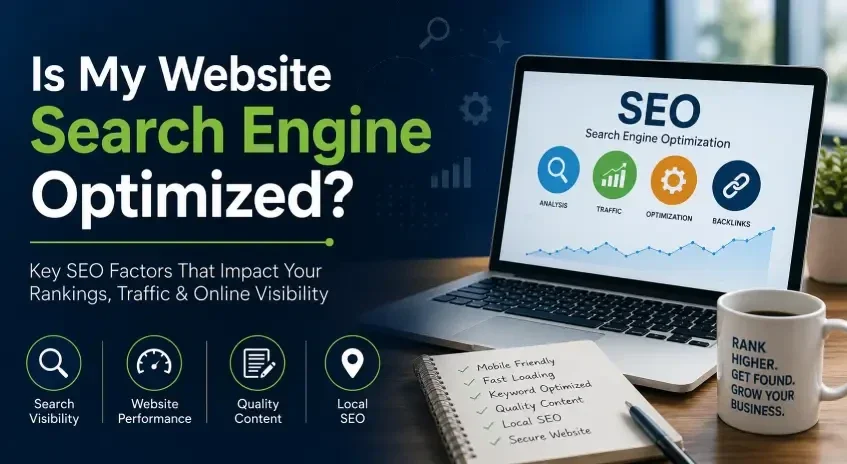
"Is My Website Search Engine Optimized?"
This is one of the most common questions I hear whenever a business owner contacts me about their existing website. Many people assume that because they have a website, Google will automatically find it and send them customers. Unfortunately, that isn't how search engines work.
The truth is that thousands of websites are launched every day, and most of them never generate meaningful traffic because they aren't properly optimized for search engines.
Having a website is important, but having a website that can actually be found by potential customers is what really matters.
In this article, we'll cover some of the key factors that determine whether your website is optimized for search engines and what you can do to improve your visibility online.
What Does Search Engine Optimization (SEO) Mean?
Search Engine Optimization, commonly known as SEO, is the process of improving your website so search engines like Google can understand its content and rank it for relevant searches.
For example, if you're a roofing contractor in Houston, you would want your website to appear when someone searches for phrases like:
-
Roofing contractor near me
-
Roof repair in Houston
-
Residential roofing company
-
Emergency roof repair
SEO helps search engines connect your website with people who are actively looking for the products or services you offer.
Without SEO, your website is like a billboard placed in the middle of the desert. It may look great, but very few people will ever see it.
Is Your Website Mobile-Friendly?
One of the first things Google looks at is how well your website performs on mobile devices.
Today, more than half of all internet traffic comes from smartphones and tablets. If your website is difficult to navigate on a mobile device, visitors will quickly leave and Google will notice.
A mobile-friendly website should:
-
Load quickly
-
Display correctly on all screen sizes
-
Have easy-to-read text
-
Include buttons that are easy to tap
-
Provide a smooth user experience
If your website was built several years ago and has not been updated recently, there is a good chance it may not meet Google's current mobile standards.
How Fast Does Your Website Load?
Website speed is another major ranking factor.
Think about your own browsing habits. If a website takes more than a few seconds to load, you're likely to leave and visit a competitor's website instead.
Google knows this and rewards websites that provide a fast user experience.
Common causes of slow websites include:
-
Oversized images
-
Poor web hosting
-
Excessive plugins
-
Unoptimized code
-
Large video files
A slow website doesn't just hurt your rankings—it can also cost you potential customers.
Does Your Website Target the Right Keywords?
Keywords are the phrases people type into Google when searching for products and services.
Many business websites make the mistake of focusing on what they want to say instead of what customers are actually searching for.
For example, a business owner might describe their company as a "full-service exterior restoration specialist," while potential customers are searching for "roof repair company (fixing that kind of mismatch is a core part of our website design service).
Keyword research helps identify the terms your ideal customers are using so your website content can align with their searches.
Every important page on your website should be optimized around a specific keyword or search phrase.
Do You Have Quality Content?
Content remains one of the most important elements of SEO.
Google wants to provide users with helpful, relevant, and trustworthy information.
Ask yourself:
-
Does your website answer common customer questions?
-
Do you regularly publish helpful articles?
-
Are your service pages detailed and informative?
-
Does your content demonstrate expertise?
Many websites have only a few paragraphs of text on each page. That's often not enough to compete with businesses that consistently publish useful content.
A well-maintained blog can significantly improve your search visibility over time.
Every article you publish creates another opportunity for potential customers to discover your business.
Are Your Page Titles and Meta Descriptions Optimized?
Behind every webpage are two important pieces of information:
Title Tags
The title tag tells Google what the page is about.
A poor title might look like:
Home
A better title would be:
Roof Repair Services in Houston | ABC Roofing
Meta Descriptions
The meta description is the short summary that often appears beneath your listing in search results.
A well-written meta description can increase click-through rates and help attract more visitors.
Many websites either ignore these elements or use duplicate titles across multiple pages, which can hurt SEO performance.
Are You Using Proper Headings?
Headings help both visitors and search engines understand your content.
Your pages should typically include:
-
One H1 heading
-
Multiple H2 headings
-
Supporting H3 headings where appropriate
Think of headings as the outline of your page.
Proper structure improves readability and helps search engines understand the hierarchy of information.
Is Your Website Secure?
Google prefers secure websites.
If your website URL begins with:
https://
you are likely using an SSL certificate.
If it begins with:
http://
without the "s," your site may not be secure.
Visitors are much less likely to trust a website that displays security warnings, and Google may rank those websites lower.
Have You Optimized Your Images?
Images can improve user experience, but they can also slow down your website if they are not properly optimized.
Every image should include:
-
Appropriate file sizes
-
Descriptive file names
-
Alt text descriptions
Alt text helps search engines understand what an image represents and can improve accessibility for users with visual impairments.
Does Your Website Have Local SEO Signals?
For local businesses, local SEO is critical.
Google needs clear signals that identify where your business operates.
Some important local SEO elements include:
-
Consistent business name, address, and phone number
-
A fully optimized Google Business Profile
-
Local citations and directory listings
-
Location-specific service pages
-
Customer reviews
These signals help Google connect your business with local searches in your service area.
Are Other Websites Linking to Yours?
Backlinks are links from other websites that point to your site.
Think of backlinks as votes of confidence.
When reputable websites link to your content, Google sees those links as indicators of trust and authority.
However, not all links are equal.
A few high-quality backlinks from trusted websites are often far more valuable than hundreds of low-quality links.
Building quality backlinks remains one of the most powerful SEO strategies available today.
Can Search Engines Actually Crawl Your Website?
You would be surprised how many websites contain technical issues that prevent search engines from properly indexing their pages.
Common issues include:
-
Broken links
-
Missing pages
-
Duplicate content
-
Crawl errors
-
Improper redirects
-
Missing XML sitemaps
These problems often go unnoticed because they are invisible to the average visitor.
However, they can have a significant impact on search rankings.
The Bottom Line
If you're asking yourself, "Is my website search engine optimized?" the answer is usually more complicated than a simple yes or no.
SEO involves dozens of factors working together, including website speed, mobile usability, keyword optimization, content quality, technical performance, local SEO signals, and backlinks.
The good news is that most websites have opportunities for improvement.
Even small changes can lead to better rankings, increased traffic, and more leads over time.
If you're not sure where your site stands, our services FAQ covers what SEO actually involves and what it tends to cost.
Request Your Free Website SEO Report
Want to know how your website is performing in search engines?
At LocalBizNet, we provide a comprehensive SEO analysis that identifies strengths, weaknesses, and opportunities for improvement. We'll evaluate your website's technical performance, on-page optimization, local SEO signals, content strategy, and overall search visibility.
If you're serious about generating more traffic, leads, and customers from your website, contact us today and request your complimentary Website SEO Report.
You'll receive valuable insights into your current SEO performance and discover practical ways to improve your rankings and online visibility.