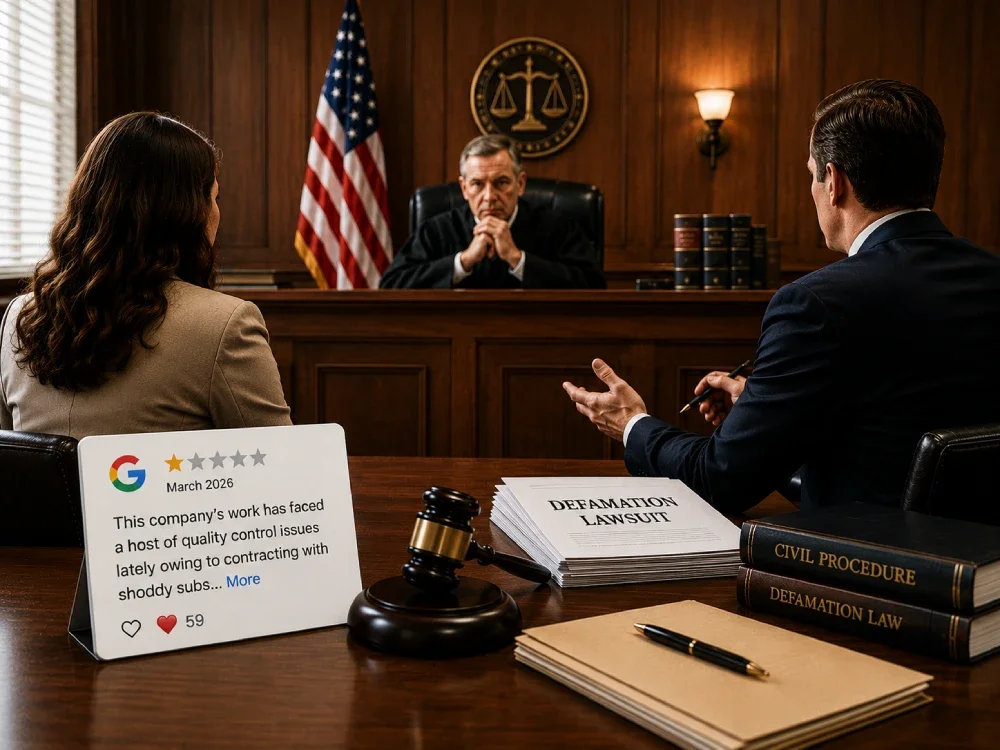
A one-star Google review has now become the subject of a defamation lawsuit seeking damages in excess of $25,000.
For consumers, a case like this can raise an obvious concern: Can you really be sued simply for leaving a bad review?
For business owners, it raises a very different question: When does a negative review cross the line from protected criticism into something that can actually be challenged legally?
The answer to both questions is more complicated than the headline might suggest. The important distinction isn't whether a review is negative. It's what the reviewer actually says, whether those statements are true, and whether the statements cross the legal boundaries of protected opinion and factual criticism.
Here's what happened in a case involving a dissatisfied consumer and a manufacturing business, what the lawsuit alleges, and what both consumers and business owners should take away from it.
Author, Steve Davies - LocalBizNet.com
The Review That Led to a Lawsuit
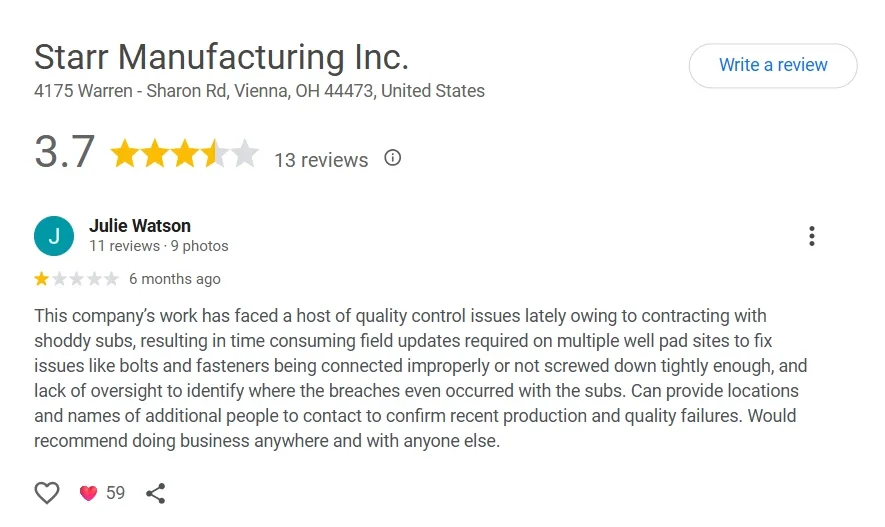
Starr Manufacturing Inc., based in Vienna Township, Ohio, has filed a lawsuit against Julie Watson of Columbus over a one-star review she posted to the company's Google Business Profile in March 2026.
A Google Business Profile is the free business listing that allows a company to manage how it appears in Google Search and Google Maps. Customer reviews are one of the most visible parts of that profile and can have a significant effect on how potential customers perceive a business.
According to Starr Manufacturing's complaint, Watson's review alleged that the company had experienced product-quality and manufacturing failures that affected multiple customers.
The company claims those statements were false and caused both financial and reputational harm. Starr is asking a jury to award more than $25,000 in damages, in addition to attorney fees and litigation costs.
At the time the lawsuit was filed, the review remained publicly visible and was one of only 13 reviews on the company's Google profile.
What Does "More Than $25,000" Actually Mean?
The dollar figure in the lawsuit may sound significant, but it is important not to interpret "$25,000" as Starr Manufacturing's actual target amount or as a prediction of what the company will ultimately receive.
Under Ohio's civil procedure rules, when a plaintiff is seeking more than $25,000 in damages for a claim of this type, the complaint must indicate that the damages exceed that threshold without stating the specific amount being sought.
The rule exists in part because plaintiffs historically could include extremely large dollar figures in lawsuits, even in relatively minor disputes, potentially creating pressure on defendants to settle simply because of the number appearing in the complaint.
As a result, the complaint uses language indicating that the damages are "in excess of $25,000."
That could ultimately mean $30,000, $100,000, $1 million, or something else entirely. The number in the complaint should therefore not be treated as an estimate of what a jury will award. It is essentially a procedural threshold rather than a damages prediction.
Why Starr Manufacturing Says the Review Was Defamatory
The lawsuit is based on two legal theories that are important for anyone who writes or manages online reviews to understand.
The first is defamation per se.
Defamation per se refers to statements considered so inherently damaging to someone's reputation that the law can presume harm rather than requiring the plaintiff to prove a specific dollar amount of damage.
That does not mean, however, that every negative statement about a business automatically qualifies.
When a private individual is sued over commentary concerning a product or service, the business generally still has to establish actual malice. In this context, that means the reviewer either knew the statement was false or acted with reckless disregard for whether it was true.
The second legal theory is defamation by implication.
This type of claim focuses not necessarily on what the reviewer explicitly said, but on the impression the statements allegedly created.
Starr Manufacturing argues that Watson's review gave readers the impression that other customers had experienced the same problems she described, even though the review itself was based on her own experience.
The Difference Between an Opinion and a False Statement
This distinction may ultimately become one of the most important issues in the case.
An Ohio appeals court ruling from September 2024 drew an important line between protected opinions and statements based on fabricated facts.
A star rating by itself is protected speech. So is an honest opinion about a product or service.
For example, saying "I wouldn't recommend this company" is generally an expression of opinion.
Likewise, a customer describing what happened during their own interaction with a business is fundamentally different from knowingly inventing an event that never occurred.
The court's distinction is important because a negative review does not lose its legal protection simply because a business strongly disagrees with it.
The more important question is whether the review is based on a genuine experience and honestly expressed, or whether it contains fabricated factual claims.
Exactly where Watson's review falls along that line will likely be central to the lawsuit as it moves forward.
At this point, the case is still ongoing. No ruling or settlement has been reported.
As additional information becomes available, this article can be updated or a follow-up article can provide the latest developments.
Does This Lawsuit Mean You Should Be Afraid to Leave a Review?
A headline about a business suing someone over a one-star Google review can understandably make people hesitate before posting their own experiences.
But that is not the lesson consumers should take from this case.
Consumers have the right to share their honest experiences with businesses. That includes experiences that are positive, negative, or somewhere in between.
If a product didn't work as expected, a repair took longer than promised, or customer service was disappointing, those are precisely the kinds of experiences customer reviews are designed to communicate.
The potential legal problem isn't simply being critical.
The greater concern arises when someone states something as a fact that isn't true — particularly when the person knows the statement is false or acts recklessly regarding whether it is true.
Ohio's Anti-SLAPP Protection
There is another important development consumers should be aware of.
In January 2025, Ohio adopted the Uniform Public Expression Protection Act, commonly referred to as UPEPA. The law provides anti-SLAPP protections.
SLAPP stands for Strategic Lawsuit Against Public Participation. The term generally describes litigation intended, at least in part, to pressure someone into silence or make public participation financially burdensome.
UPEPA gives people facing certain lawsuits involving protected expression a formal mechanism to ask a court to dismiss the case at an early stage.
If the defendant prevails under the law's applicable procedures, the business that brought the lawsuit may also be responsible for attorney fees.
That provides an important safeguard against using litigation simply as a way to intimidate someone into removing legitimate criticism or remaining silent.
How Consumers Should Approach Online Reviews
The safest and most useful approach is actually fairly simple:
Tell the truth about your own experience.
Describe what happened. Explain what you liked or didn't like. If something went wrong, explain the problem without turning assumptions into established facts.
For example, there is an important difference between saying:
"I had a problem with the product I purchased."
and making a much broader statement claiming:
"This company’s work has faced a host of quality control issues lately owing to contracting with shoddy subs", which incidentally is what the review listed in this lawsuit actually says.
The first describes an individual experience. The second makes a much broader factual allegation that may require evidence.
There's another reason to think twice before leaving a negative review: your review history is public, too.
When someone considers your review, they may be able to look at your other reviews and see a pattern. If nearly every business you review receives one or two stars and another negative comment, readers may begin to question whether the problem is always with the businesses — or whether you're simply someone who tends to leave negative reviews.
In other words, even a legitimate complaint can lose some of its impact when it appears alongside a long history of consistently negative reviews. A potential customer may begin to question whether the reviewer is a serial negative reviewer, which could cause them to view the individual complaint with more skepticism.
That's why it's worth asking yourself a simple question before posting: Am I leaving this review because I genuinely had a problem that other consumers should know about, or am I simply angry in the moment?
If you have a legitimate complaint, say what happened and explain it fairly. A review that is specific, factual, and balanced is far more likely to be taken seriously than one that simply attacks the business.
And there's one more important point: stick to your own experience.
Even when you have a legitimate complaint, be careful about extending your experience to other customers. Saying that you received a defective product or experienced poor service is very different from stating that other customers had the same experience.
Unless you have concrete evidence to support that broader claim, it's better to let other customers speak for themselves. That's particularly important in light of the allegations in the Starr Manufacturing lawsuit, where the company claims the review implied that other customers had experienced similar problems.
What Small Businesses Should Do When a Bad Review Appears
For business owners, the appearance of a damaging or seemingly unfair review can be frustrating.
The natural reaction may be to ignore it, argue with the reviewer publicly, demand that it be removed, or — in particularly serious situations — consider legal action.
But in most cases, a lawsuit should not be the first tool a business reaches for.
There is something much more practical that businesses can do every day:
That means responding not only to negative reviews, but to positive reviews as well.
A business that consistently responds demonstrates to existing and potential customers that someone is actually paying attention.
An unanswered negative review simply remains on the profile, appearing to future customers as though the business never addressed the complaint.
A thoughtful response changes that dynamic. In some cases, the way a business handles a negative review can create more confidence than a collection of five-star reviews that receive no response at all.
How to Respond Without Making the Situation Worse
The tone of a response is extremely important.
A defensive, dismissive, or argumentative response rarely helps — even when the business genuinely believes the reviewer is wrong.
Remember that the response isn't being written only for the person who left the review. Every future customer who reads the review will see the business's response, too.
A better strategy is to acknowledge the customer's experience, remain professional, and offer to investigate the situation.
For example:
"We're sorry to hear you had this experience — that's not the standard we hold ourselves to. We're going to look into what happened and address it internally so it doesn't happen again if we find your experience reflects a real issue on our end. We'd also welcome the chance to make this right — please reach out to us directly at [contact info] so we can follow up."
There is an important distinction in this type of response.
The business isn't automatically admitting that the customer's allegations are true. At the same time, it isn't getting into a public argument.
Instead, it acknowledges the customer's experience, demonstrates a willingness to investigate, and creates an opportunity to resolve the matter privately.
What If the Review Really Is Wrong?
Being professional does not mean a business has to agree with something it knows to be factually incorrect.
If the company's records contradict the review, it can say so — but it should do it calmly and without turning the response into a public fight.
For example, a business might explain that its records do not reflect the events described and invite the reviewer to contact the company directly so the situation can be investigated.
The goal should be resolution rather than confrontation.
That distinction matters because the response isn't just about winning an argument with the reviewer. It is about communicating with every potential customer who may read the exchange months or even years later.
People generally respond better to a business that appears interested in solving a problem than one that appears determined to prove a customer wrong.
And if an internal investigation reveals that the business actually made a mistake, fixing that problem is far more valuable than winning an argument online.
In some situations, a follow-up from the business showing that an issue was investigated and addressed can even turn a negative review into an example of good customer service.
When Might Legal Action Actually Make Sense?
There may be circumstances where legal action is appropriate.
But generally speaking, it should be considered a last resort, particularly when the dispute involves an ordinary negative review.
A business considering litigation should be looking at circumstances involving genuinely fabricated claims, meaningful and demonstrable harm, and facts that support the legal elements of a defamation claim.
A customer saying, "I hated the service" is very different from knowingly publishing a fabricated factual allegation designed to damage a business.
Most negative reviews — even harsh or unfair ones — do not rise to the level of defamation.
And pursuing litigation carries its own costs, including attorney fees, time, uncertainty, and the possibility of additional reputational attention.
The Starr Manufacturing lawsuit is unusual precisely because most disputes over negative reviews never reach this point. How this particular case is ultimately resolved could provide another useful example of where courts draw the line between legitimate criticism and actionable statements.
The Bottom Line for Consumers and Businesses
The Starr Manufacturing case is a useful reminder that online reviews have real consequences.
For consumers, that doesn't mean you should stop leaving negative reviews. It means you should be thoughtful about when and how you leave them. Make sure your review is based on your actual experience, stick to the facts, and remember that the credibility of your review can be influenced by how you conduct yourself across the review platforms.
For business owners, the lesson is different.
A negative review does not automatically represent a legal problem. In most cases, the better response is to consistently manage your reputation, respond professionally to criticism, investigate legitimate complaints, and give customers an opportunity to resolve problems directly.
Businesses have far more to gain from demonstrating that they listen and care than from treating every negative review as an attack that needs to be fought.
And when a review truly does appear to contain fabricated and damaging factual claims, legal remedies may exist — but those situations require careful evaluation rather than an immediate reaction.
For now, the Starr Manufacturing case remains unresolved. We'll continue following it and will share an update once there is a significant development or the case reaches a resolution.
Sources
- Tribune Chronicle, "Vienna business suing over bad Google review":
https://www.tribtoday.com/news/local-news/2026/08/vienna-business-suing-over-bad-google-review/ - WFMJ, "Trumbull County company sues Ohio woman for her Google review":
https://www.wfmj.com/news/local-news/trumbull-county-company-sues-ohio-woman-for-her-google-review/article_298b270c-dc26-46f2-a148-940508936548.html - Hoodline, "Vienna Township Manufacturer Sues Columbus Woman Over One-Star Google Review":
https://hoodline.com/2026/08/vienna-township-manufacturer-sues-columbus-woman-over-one-star-google-review/ - Local12/WKRC, "Ohio company sues woman over scathing 1-star Google review":
https://local12.com/news/nation-world/ohio-company-sues-woman-negative-google-review-starr-manufacturing-vienna-township-columbus-lawsuit-defamation-one-star-review-damages-cincinnati-compensation-punitive-attorney-fees-reputation-malicious-false-claims-jury-trial-business - Reporters Committee for Freedom of the Press, "Ohio Anti-SLAPP":
https://www.rcfp.org/anti-slapp-guide/ohio/ - Frantz Ward LLP, "Ohio Enacts Uniform Public Expression Protection Act, Establishing Anti-SLAPP Protections":
https://www.frantzward.com/ohio-enacts-uniform-public-expression-protection-act-establishing-anti-slapp-protections/ - WKYC, "Ohio's new anti-SLAPP law helps protect against meritless defamation lawsuits: Legally Speaking":
https://www.wkyc.com/article/life/legally-speaking/ohio-35th-state-anti-slapp-law-additional-protection-against-improper-defamation-lawsuits-legally-speaking/95-5efa8150-05eb-40fb-9e8a-d8e14029b5d4
This article is for general informational purposes only and does not constitute legal advice.
Readers with questions about a specific legal situation should consult a licensed attorney.
This is a screenshot of the Google review in question and was created at the time this article was written
Frequently Asked Questions