


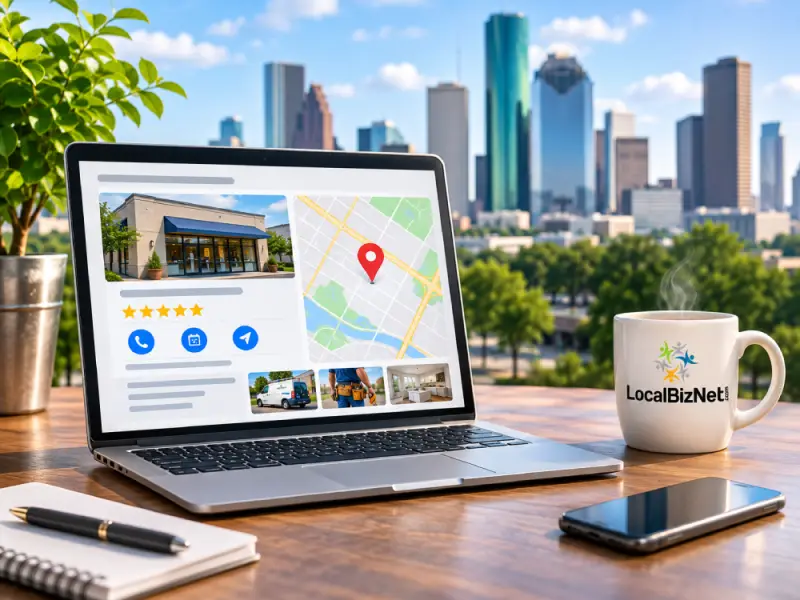
Most business owners I talk with think of their Google Business Profile as something they set up once and checked off the list. The trouble is that your customers don't see it that way. When someone in Houston needs a plumber, a dentist, a roofer, or an attorney, the first impression of your company often happens in Google Maps, long before they visit your website or pick up the phone.
Wrong hours, an old phone number, outdated photos, or a handful of unanswered reviews can quietly send those customers to a competitor, even when you do better work.
In this article, I walk through what Google looks at when it decides which local businesses to show, and the practical steps that help turn your profile into a trust signal that brings in calls, visits, and appointments. If you've ever wondered why a competitor keeps showing up ahead of you, this is a good place to start.
By Steve Davies | Founder, LocalBizNet.com
When a Houston homeowner searches "emergency plumber near me" at 8:00 p.m., they are not comparing marketing strategies. They are choosing from the handful of businesses Google puts in front of them. Google says it ranks local results on three things: relevance, distance, and prominence. In plain terms, that means how well your business matches the search, how close you are to the person searching, and how well known and trusted your business appears across the web. Google Business Profile optimization in Houston is how local companies improve their chances of showing up in that moment and turning that visibility into calls, appointments, and visits.
I've worked with businesses across Kingwood, Humble, Atascocita, The Woodlands, Spring, Conroe, and Greater Houston since 2006, and the pattern hasn't changed. A Google Business Profile is not a listing you set up once and forget. It is a public trust asset. A thin, outdated, or
poorly reviewed profile can send ready-to-buy customers to a competitor, even when your company does better work.
Why Google Maps Visibility Has Real Business Consequences
Google's local results are built to help people make fast decisions. Someone looking for a dentist, roofer, attorney, electrician, restaurant, or auto repair shop usually wants a nearby business they can trust right now. Most will call one of the first few well-reviewed options in
Google Maps and never scroll further.
That makes local visibility about more than ranking for a phrase. Google is weighing whether your business looks legitimate, active, accurate, and relevant to the search. A strong profile answers a customer's basic questions before they ask them. Do you serve my area? Are you
open? What do other customers say? Can I call, book, or get directions easily?
A profile with the wrong hours, an old phone number, generic photos, unanswered reviews, or a vague service list creates doubt, and doubt costs leads. That gets expensive fast for high-value local services. One missed personal injury case, roofing estimate, new dental patient, or
commercial HVAC call can be worth far more than what it costs to keep a profile in good shape.
Optimization Is a Trust Strategy, Not a Keyword Exercise
Many businesses still treat local SEO as a keyword game. Keywords matter, but they are only one piece. Google and your future customers are both looking for signs that your company is the established, credible local choice. A properly optimized profile ties together accurate business information, the right categories, clear services, real customer reviews, recent activity, good photos, and a website that backs it
all up. Those details should also match what appears across the major online directories and anywhere else your business is mentioned.
This matters even more now that customers use AI tools like ChatGPT, Gemini, and Google's AI Overviews, along with voice search, to find local businesses. These platforms look for consistent facts and credible evidence across the web. If your Google profile says one thing,
your website says another, and your directory listings are incomplete, your business becomes harder to trust and harder for those tools to recommend. For a Houston-area electrician, that might mean clearly listing electrical repair, panel upgrades, EV charger installation, and the cities served.
For a family dentist, it might mean showing current office photos, appointment options, and a steady stream of thoughtful patient feedback. The details change by industry, but the goal stays the same: make it easy for both Google and customers to see why your business is a relevant local choice.
Start With the Information Customers Rely On
Everything starts with accuracy. That sounds obvious, yet I regularly find local profiles with duplicate locations, outdated categories, old holiday hours, disconnected phone numbers, or service areas that no longer reflect the business. Your business name, address, phone number, website, hours, and primary category must match reality. Don't stuff keywords into your business name, and don't choose categories that don't describe what you do. Those shortcuts can create confusion, invite edits from the public, and put your profile at risk of suspension.
Choose Categories With Intent in Mind
Your primary category carries a lot of weight because it tells Google what your business fundamentally is. A plumbing company shouldn't pick a broad category because it sounds appealing when a more precise plumbing category exists. Secondary categories can support
real services you offer, but they shouldn't turn the profile into a grab bag. Category choices should reflect what customers search for when they are ready to act. A personal injury lawyer needs a different local search strategy than a general practice firm. A
restaurant that also caters needs to show both without diluting what it is known for.
Write a Description and Use Attributes That Help Customers Decide
Your business description gives you room to explain who you are, what you do, and who you serve in your own words. Write it for a person, not a search engine. Lead with your core service, mention the communities you serve naturally, and include what sets you apart, such as years in business, certifications, or guarantees. Leave out links, promotions, and lists of keywords. Attributes are the small details Google shows on your profile, like wheelchair accessibility, online appointments, payment options, or identifying as veteran-owned or women-owned. They're easy to overlook, but they answer questions customers care about and help your profile stand out next to a competitor who skipped them. Build Out Services, Products, and Service Areas Carefully
The services and products sections let you describe the work you provide. Use clear, customer friendly language: name the service, explain it briefly, and avoid repeating the same city names over and over.
Service-area businesses need special care. A company based in Kingwood may serve Humble, Atascocita, Porter, New Caney, and The Woodlands, but it shouldn't claim all of Texas. Overreaching doesn't create qualified visibility. It brings in irrelevant calls and makes the profile
less credible to both customers and Google. The same goes for addresses: a virtual office or mailbox address used to appear in another part of town is one of the most common reasons I see profiles get suspended.
Reviews Are Proof, Not Decoration
For most local buyers, how many reviews you have and how recent they are shape the decision as much as rankings do. A roofing contractor with 175 recent, detailed reviews will usually inspire more confidence than a competitor with six reviews from three years ago. The same
holds for medical practices, restaurants, attorneys, auto shops, and home service companies. The goal isn't a perfect score through artificial tactics. It's to consistently earn honest feedback from real customers after real transactions. Offering incentives for reviews, or asking only happy customers to post (often called review gating), violates Google's policies, and fake or bought reviews can bring trouble with the Federal Trade Commission. A good review request process is simple, timely, and built into normal operations. Ask when the customer has just experienced the value of your work, not weeks later when the job is a fading memory. How you respond matters too. Thank customers specifically when it fits, address concerns professionally, and never argue in public. A calm, professional reply to a negative review shows
future customers that your business is accountable. In regulated fields like healthcare and law, responses must also protect privacy and never confirm or reveal client or patient details. An occasional critical review won't sink a trustworthy business. Ignoring every review, collecting repetitive suspicious feedback, or leaving complaints unanswered creates a very different impression.
Use Photos and Posts to Reduce Customer Hesitation
People want evidence that a local business is real, current, and capable, and photos do much of that work. Contractors can show completed projects, branded vehicles, crews, and before-and after shots where appropriate. Restaurants can show the dining room and real menu items. Medical offices can show a clean, welcoming space and staff photos that help new patients feel at ease before they arrive. Don't rely only on stock photography. Professional images have value, but authentic photos of your location, work, people, and equipment usually build more confidence. Keep them current. If you've renovated the office, rebranded your trucks, or your team has changed, the profile should show it. Google Posts can support promotions, updates, seasonal services, events, and announcements. They don't replace a complete profile or a review strategy. Use them when you have something worth saying, such as storm-preparation inspections for a roofer, holiday hours for a retail store, or a new service at an accounting firm.
Your Website and Listings Must Support the Profile
A Google Business Profile doesn't work alone. When a customer clicks through, your website should carry the same trust message, with clear service pages, local relevance, fast mobile performance, accurate contact information, and easy ways to call or request service.
The profile may earn the first click, but a weak website can lose the lead. If a homeowner lands on a confusing page with no service details, no proof of experience, and no visible phone number, they'll go back to Maps and call someone else. Consistency across online listings matters as well. Differences in your business name, address, suite number, phone number, or hours create confusion for customers and for search engines. This happens often after a move, an ownership change, a rebrand, or a new phone system. Cleaning up those details gives you a more reliable local presence.
Measure Leads, Not Just Ranking Positions
Rankings shift based on where the searcher is standing, what device they're using, and what the competition is doing. Houston's size makes this especially true. A top position for someone searching downtown may look completely different to someone searching from Kingwood or
Cypress. That's why reporting should connect visibility to business results. Track calls, direction requests, website visits, appointment requests, form leads, review growth, and the quality of the inquiries you receive. Adding a tracking tag (a UTM code) to the website
link on your profile lets you see in Google Analytics exactly how many visitors and leads the profile sends you. A lower-volume search term that brings in profitable commercial jobs may be worth more than a popular phrase that attracts price shoppers from outside your service area. This is where ongoing management earns its keep. Profiles need regular attention, especially after Google feature changes, business updates, new reviews, or a suspension. I approach this work as connected reputation and visibility management, not a one-time listing task, and that approach has served Greater Houston businesses well for over 20 years.

Give Customers One Clear Reason to Choose You
Your Google Business Profile should tell a nearby customer one thing clearly: this business is active, credible, easy to reach, and ready to help. Keep building that proof every week, and the calls, visits, and stronger local reputation will follow. If you're not sure how your profile compares to the competitors showing up ahead of you in Google Maps, I'm happy to take a look. Reach out through LocalBizNet, and I'll show you what's working, what's holding your profile back, and where to focus first